
The Making of a Master
Seventy years ago, the Dodgers' signed a lefthanded Jewish kid from Brooklyn. It worked out well.

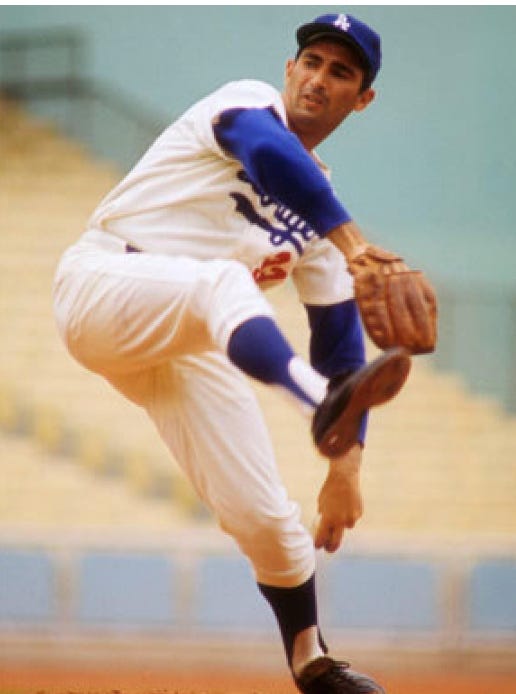
His sport was basketball and his plan was to be an architect, following the blueprint drawn up by his uncles. Sanford (Sandy) Koufax, star center for Lafayette High School in Brooklyn, had it all figured out. He would take his basketball scholarship to the University of Cincinnati, study engineering and industrial design, and make buildings.
It might’ve unfolded that way were it not for a man named Milton Laurie, who looked at Sandy Koufax and didn’t see a high-jumping 6-foot, 2-inch rebounding machine, or an architect. He saw one of the greatest left arms in his baseball life.
And so it was that 70 years ago – on December 14, 1954 - the 18-year-old Koufax signed for a reported $20,000 and joined the baseball club from his home borough, the Dodgers. It was one of the most serendipitous pitching finds in the annals of one of baseball’s most storied clubs – one with a long line of pitching royalty, from Vance to Valenzuela, Newcombe to Drysdale, Hershiser to Sutton, and yes, Koufax to Kershaw. Al Campanis, legendary scout and future general manager, was the man who got young Koufax to sign, even though the Milwaukee Braves offered $10,000 more. Irving Koufax, Sandy’s stepdad, had given the Dodgers his word. His word was good. Very good.
"There are two times in my life the hair on my arms has stood up: The first time I saw the ceiling of the Sistine Chapel and the first time I saw Sandy Koufax throw a fastball,” Campanis told Jane Leavy, author of a wonderful bestselling biography, "Sandy Koufax: A Lefty's Legacy,"
A former ballplayer who once signed with the Boston Braves, Laurie was the longtime sandlot manager of a team called the Parkviews. He was also the father of one of Koufax’s good friends. At his father’s urging, Laurie’s son, Walter, encouraged Sandy to join the Parkviews, a club a number of their friends were playing on. Koufax, who had a summer job as a counselor at a camp in the Catskills, initially declined, but Walter persisted. Koufax had played ball the previous summer for a team called the Tomahawks in the Ice Cream League, and the elder Laurie was impressed, even though Koufax walked nine hitters in two innings one of the times Laurie scouted him. Koufax eventually agreed to join his friends on the Parkviews, but wasn’t sure what to expect. He was a basketball player, after all, an all-city talent who even impressed the Knicks when they scrimmaged the Lafayette team in a charity game.
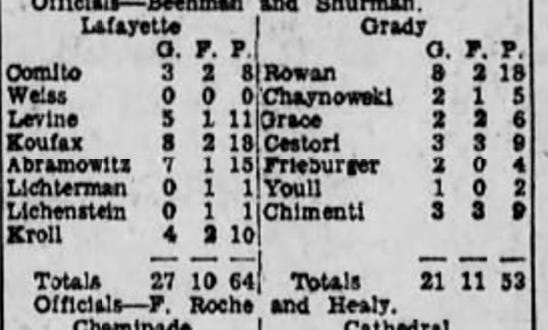
“I’d always played first (base), and when Milton asked me to play with the Parkviews, I thought I’d play first,” Koufax told columnist Jimmy Cannon of the Daily News. “But Mr. Laurie told me I was going to pitch.” Koufax did as he was told. He pitched a three-hitter and didn’t throw anything but fastballs.
Clearly, Milton Laurie was on to something, and when Koufax followed a fine freshman season with the Cincinnati basketball team by striking out 58 hitters in 30 innings for the UC freshman baseball team, well, the secret wasn’t much of a secret, anymore. Almost every club in the majors approached him, including the Dodgers’ New York rivals, the Yankees and Giants. Dodgers owner Walter O’Malley prized the kid’s potential, and didn’t mind that he was Jewish, either.
“We hope he’ll be as great as Hank Greenberg or Sid Gordon,” O’Malley said. “But we don’t want to be accused of discriminating against the Irish.”
In the spring of 1955, Koufax reported to Vero Beach. By the rules in place at the time, the Dodgers had to keep him on the big-league roster for two years. Koufax would never throw a pitch in the minors. He suffered a foot injury that spring. The Dodgers brought him along slowly. He didn’t make his big-league debut until June 24. More than 43,000 fans turned out in Milwaukee’s County Stadium. Carl Erskine, the starter for the first-place Dodgers, got roughed up early, giving up home runs to Eddie Mathews, Del Crandall and the National League’s reigning Rookie of the Year, Henry Aaron.
In the bottom of the 5th, manager Walter Alston called for Koufax. The first batter he ever faced, shortstop Johnny Logan, flared a single to right. Koufax made an error on a comebacker, then walked Aaron on four pitches. Three batters into his first appearance, Koufax was surrounded by baserunners with nobody out. Bobby Thomson, whom the Braves acquired from the Giants a year earlier, came to the plate. The count went to 3-2. Koufax fired and Thomson swung and missed. Koufax had the first strikeout of his career, and moments later, escaped the first jam of his career, getting Joe Adcock to ground into a double play.
With a strong, well-muscled back, big hands and long fingers, Koufax had a high leg kick and quickly established himself as perhaps the hardest thrower in the game. Add in a devastating overhand curveball that would start at a hitter’s shoulders and end near his ankles, and you had an arsenal nobody could match. The only trouble was he had little idea where the ball was going.
"When he (Koufax) first came up, he couldn't throw a ball inside the batting cage," Hall of Fame teammate Duke Snider said.
The Dodgers proceeded cautiously with Koufax, allowhim to pitch only 41.2 innings in 1955, and none at all in the World Series, when the Dodgers finally got past the Yankees and won their first Series title. Shortly after Johnny Podres finished off his 2-0 masterpiece, Koufax was off to Columbia University, where he was taking architecture classes.
Koufax didn’t become a regular in Alston’s starting rotation until the club moved to Los Angeles in 1958, but his control problems made the westward trip, too. He won 11 games, but also lost 11, walking105 hitters in 158.2 innings and leading the league with 17 wild pitches. Though he was still only 22, Koufax and plenty of others were frustrated with his lack of progress, and when he went 8-13 in 1960 with a 3.91 ERA, he considered giving up baseball to spend more time in an electronics business he had invested in.
It was the spring of 1961 that Koufax heeded some sage advice from his pitching coach, Joe Becker, and catcher, Norm Sherry. On a bus ride to an exhibition game, Sherry suggested Koufax not try to throw every fastball with everything he had. Tensing his muscles and stressing his body to the max made him wilder, and diminished the late movement on his fastball. Becker encouraged to keep his wrist loose, allowing for more snap on his release.
“Why not have some fun out there, Sandy?” Sherry said. “Don’t try to throw so hard and use more curveballs and change-ups.”
Koufax listened, and the results were almost immediate. He went 18-13 in 1961, making his first All-Star team and leading the NL in strikeouts with 269. He still had some occasional wobbles with his control, but he was embarking on six of the most dominant pitching seasons in baseball history, a run that included three Cy Young awards (in the era when there was only one given), two World Series MVP honors, and three pitching Triple Crowns (leading the league in victories, ERA and strikeouts.) After Koufax finished 1963 with a record of 25-5, a 1.88 ERA and 306 strikeouts, he threw two more complete game victories against the Yankees in the Dodgers’ sweep.
“I can see how he won 25 games. What I don't understand is how he lost five,” Yogi Berra said.
Along the way, Koufax also threw four no-hitters, including the only perfect game in Dodger history. It came on September 9, 1965, in Dodger Stadium against the Chicago Cubs. He struck out the last five hitters. He would finish the season with a record 382 strikeouts, and a mark of 26-8 and a 2.04 ERA, and somehow was even better in 1966 (27-9, 1.73 ERA, 317 Ks, 27 complete games).
And then, faster than one of his fabled fastballs, it was over, Sandy Koufax, one-time basketball star and wannabe architect, retiring at the age of 30 because of traumatic arthritis in his left elbow. In 1972, he became the youngest player ever to be enshrined in the Hall of Fame. Nobody was surprised.
I met him. Couldn't have been nicer. Youngest looking 75-year-old ever.
I knew he was a great one...this put an exclamation point on it...