
Mr. No Miss
He started playing basketball in the 1950s. He's still at it.

Welcome to Coffey Grounds, a newsletter that is often about sports and always about people, and topics, I find fascinating. If you are new here, thanks so much for visiting. If you are a regular, thank you for coming back. Please pass the word and consider supporting my work by joining our growing list of paid subscribers. This post is free, but paying customers are the only way to keep the lights on. Thanks again. - Wayne
This is a story about a man and a bucket list, but first I need to tell you about a basketball legend. His name is Larry Williams. He has 1.1 million followers on Instagram, and the editors at SLAM magazine once anointed him “The Most Dangerous Streetball Player in the World.” Williams is 45 years old. He is known for his signature move, a crossover dribble he likes to use three or four times in succession, the result often being a defender who finds himself on his duff, or at high risk of having his ankles broken. This is how Williams came to earn his nickname: Bone Collector. He prefers to be called Larry, but Bone Collector is his brand, and the name of his online clothing store, and Academy, and the aforementioned Instagram account (@bonecollector6). So he runs with it.
Bone Collector is a fixture at the famed Venice Beach (California) Courts, where star players ranging from Kevin Durant to Chris Paul to Dwight Howard have competed over the years., and where many scenes from the 1992 cult classic, “White Men Can’t Jump,” were filmed. Not far from Williams’ Los Angeles home, Venice Beach is a sandswept smorgasbord of humans in motion, a gathering place for bodybuilders, acrobats, cyclists, rollerbladers, skateboarders and assorted other fitness enthusiasts, plying their crafts and showing off their bodies and doing all of it in front of a nonstop parade of tourists.
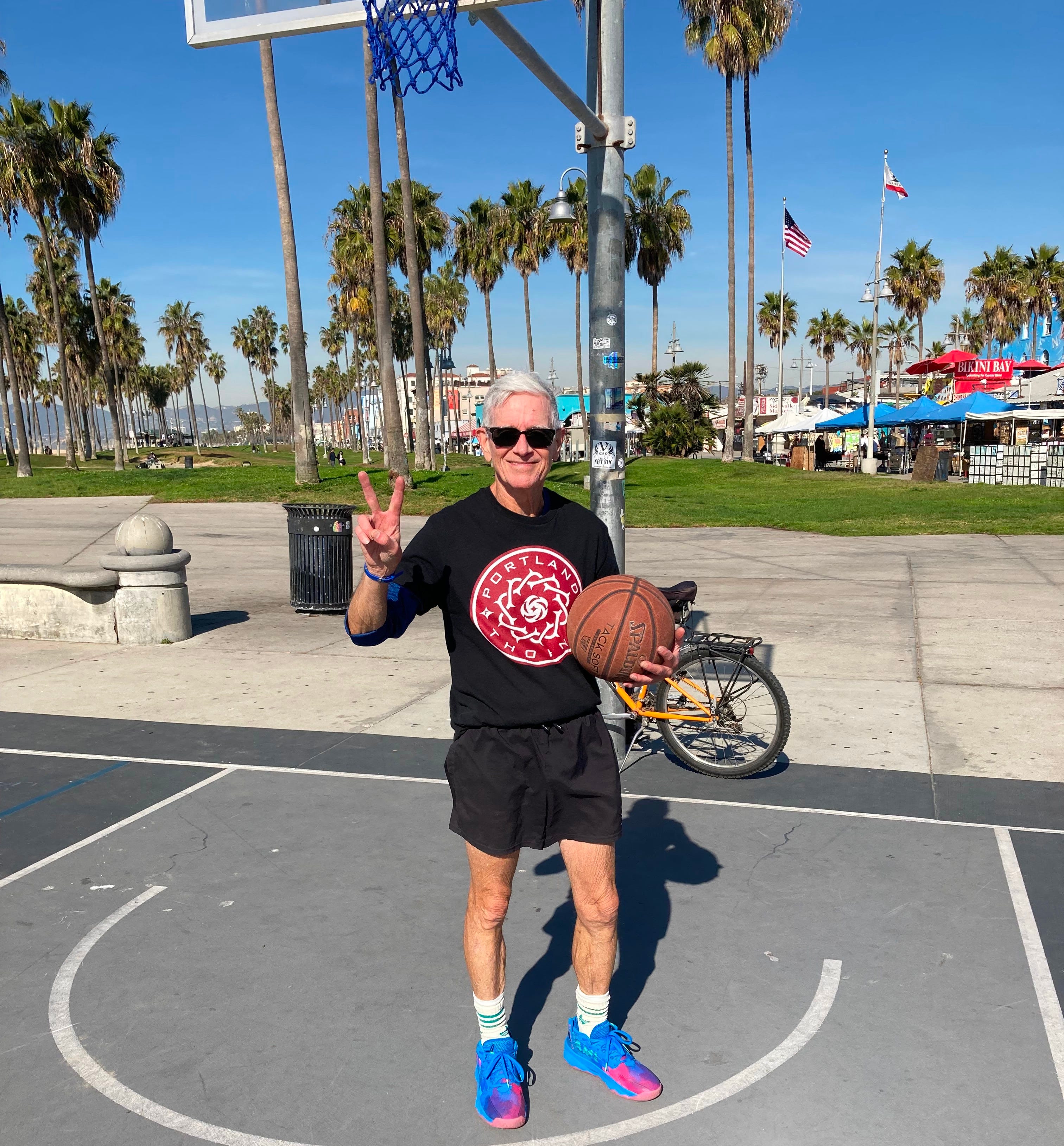
During one of his visits, Williams played a game of H-O-R-S-E with one of the court regulars, a sinewy septuagenarian with white hair and a keen sense of humor. He likes to call himself “The Geezer.” Technically, it wasn’t a game of H-O-R-S-E; it was a game of F-I-B-A-W-C, because FIBA, basketball’s world governing body, had hired Bone Collector to help promote its upcoming world championship. First, Bone Collector and another well-known street baller, Jordan Kilganon, played a round of F-I-B-A-W-C against NBA veteran Danilo Gallinari.
Gallinari prevailed in a tight contest, and then Bone Collector and Kilganon took on The Geezer. It wasn’t a fair fight. The Geezer had spent the previous five years battling metastatic cancer in his colon, liver, lungs and brain. He also had basal cell carcinoma and multiple seizures, including one that ended in a face plant on a busy street at the end of a run. He made it through a six-hour liver resection operation and two surgeries to remove brain tumors. After the second one, the surgeon said, “I recommend not having any more tumors because we can’t go in there again.”
Years of chemotherapy and radiation had done their job, but also left The Geezer weighing 116 pounds. The thought of not playing basketball was a non-starter. Basketball was his lifelong passion, a joyful through-line that went back seven decades. Bone Collector knew nothing about The Geezer’s health challenges. Nick Ansom, the founder of the Venice Basketball League, was one of the few who did.
“He’s been through all of that, and he never complains, and he’s still the best mid-range shooter out there,” Ansom said.
There are four courts at Venice Beach. Up until a couple of years ago, The Geezer would be there three or four days a week, shooting left-handed jumpers on sun-washed courts rimmed with palm trees, maybe 100 yards from the Pacific Ocean. In one shooting session — not atypical — he took 81 shots from three-point range (the Venice Court three-point line is 19 feet, 9 inches from the hoop) without missing two in a row. An unhoused person at the park named Freddy took to calling him “Mr. No Miss.” Almost 60 years earlier, he made 122 consecutive free throws at Camp All-America in the Catskill Mountains of New York. This was nothing new.
“The shot is the last thing to go,” The Geezer said. He is 79 years old now and has bulked up to 130 pounds. One of his favorite words is “counter-intuitive.” As in, “It’s counter-intuitive that I can still shoot after all these years of cancer.” His name is Frank Coffey, and he is my brother.
* * *
Cancer isn’t picky about whose life it’s going to descend on. The lucky ones catch it early. My brother was not one of them. His diagnosis came on September 1, 2014. He’d been having some intestinal issues, and his doctor recommended a colectomy, an operation to remove a piece of his large intestine. Three hours later, the doctor told him, “You have stage IV metastatic colon cancer. It’s incurable.” The doctor later regretted using the word “incurable,” but the data wasn’t much less foreboding; his cancer had a 5% survival rate.
Life became a blur of doctors’ appointments and blood draws and toxic drips. He had a port implanted in his upper chest to make the infusion process easier. His oncologist sent him home with a fanny pack to keep the chemo coming for 36 or 48 hours at a stretch. He was given the cocktail regimen cancer patients call “5-FU”, the 5 referencing the number of treatments, and the FU, well, connect the dots. Fatigue was a constant, and nausea wasn’t far behind. THC edibles were the only reason he was able to keep anything down. Severe neuropathy in his hands and feet brought on weakness, tremors or pins and needles — sometimes all three. Through all of it, when the side effects allowed, he’d get on his bike and make the 1-mile trip to the courts from his studio apartment in Marina del Rey. It lifted his spirits to be out there, in the sun, shooting baskets, visiting with the unhoused (my brother doesn’t like the word homeless). He’d bring them snacks — peanut butter Ritz crackers, apples, pears — along with a few bucks here and there. Freddy was his favorite. He grew up in Louisiana and worked as a cook for 15 years. Freddy was at the courts every day and slept where he could. He drank too much but was never anything but sweet. He used to joke to my brother, “Even when it’s windy, you don’t miss.”
* * *
My brother first fell for basketball as a sixth-grader in Huntington, Long Island. He was an athletic kid who was good at soccer and baseball, but basketball hooked him from the start. He loved the feel of the ball’s pebbled grain in his hand, and the sound of swish when the ball went cleanly through the hoop. He’d play in schoolyards, in people’s driveways, wherever, and would always let me tag along, even though I was 7 years younger. On weekends, he and his friends would look for an open window in an elementary school gym. They would slip me through the opening — I was the only one small enough to fit — and then I’d run around and open the door. When we were finished, we’d go to the cafeteria and help ourselves to Dixie Cups, dutifully leaving a dime (the going price) for each cup consumed. My brother finally convinced our father to mount a regulation-size backboard and a high-quality rim (not one of the junky ones from a toy store) over our garage. Spotlights, allowing for nighttime practice sessions, followed soon after.
Day and night, my brother was out there, shooting jumpers, working on his right hand, speed-dribbling down the driveway with one hand, speed-dribbling back with the other, imposing impossible standards on himself in both directions, aiming to be the next Bob Cousy, the fabled Boston Celtics point guard and one of his favorite players. Cousy grew up in Queens. So did our parents. My brother liked the connection.
The Geezer is generous beyond good judgment. When his niece, Alexandra, was born, we returned from the hospital to find a new TV in our apartment. He couldn’t afford to do that, but that was never a consideration. He would lend money to friends when he didn’t have much to spare. He would invite people to join him for dinner at his favorite restaurant and worry about the credit card bill later. The Geezer’s heart is huge, his patience not so much. The L.A. traffic drives him mad. You do not want to be in a parking lot with him when a fellow motorist fails to show proper courtesy. You definitely don’t want to be nearby if one of his shooting sessions isn’t going well. As a little kid on our driveway court, I dreaded it if my brother did not reach his goal of making 10 outside shots in a row to end his session. He’d yell and curse and then kick the basketball high and far into the backyard. His perfectionism could make him miserable, but it also helped make him a good player. He captained the high-school JV team and spent two years on the varsity, never a star, but always a mainstay. In his senior year, his team — John Glenn High School — beat a powerful Roosevelt High School team that had a star-in-waiting named Julius Erving. The Geezer scored a career-high 20 points that day. The future Dr. J. watched.
“He was ducking me,” my brother said.
He went on to play a couple of years at Hamilton College and then embarked on a career as an editor, and author, and screenplay writer. Basketball was never far away. His first job was as an editor at Skiing magazine; he kept a basketball under his desk so he could shoot at lunch. He played in pickup games in Manhattan and the Bronx, wherever he could find them. Later, he coached a girls’ team at a private school. I was his assistant. He taught his players John Wooden’s suffocating 2-2-1 full-court press and won 90% of his games, earning a few technical fouls along the way. He would get on the referees and apologize afterwards. He wanted them to be perfect, too.
* * *
When he first moved to Marina del Rey from New York in the 1990s, my brother played regularly in full-court games at Venice Beach. He was twice the age of most of the players and more than held his own, but then he tore a knee ligament at age 61. Surgery repaired the damage, but his days of intensely competitive games against much younger players were over.
Other challenges followed. After one of his seizures, on the ambulance ride to the hospital, the EMS technician followed protocol and asked my brother his name to assess his cognitive state. My brother answered.
“I’m Frank Coffey.”
The technician kept asking, again and again.
“I’m still Frank Coffey,” my brother said.
In need of a basketball fix one day, my brother biked to the courts and came upon Bone Collector, Jordan Kilganon and Gallinari. When their game was done, my brother suggested they run it back.
“I live for H-O-R-S-E,” he said.
My brother started with a reverse layup with his off (right) hand. Kilganon and Bone Collector both made their reverses, before my brother called, “Off the board,” and hit a shot from the left wing. It was the first of twelve shots he would take off the board during the game. He made all of them. Kilganon went cold and was the first to bow out. Bone Collector went behind his back and then through his legs before spinning in a layup.
“I’ll take a letter,” my brother said.
My brother kept making bank shot after bank shot. “Oh my God, the Backboard King!” Bone Collector said.
One letter away from losing, Bone Collector called “straight shot, no backboard” and my brother missed a couple in a row.
“War of attrition,” he said to Bone Collector. A Bone Collector miss gave my brother the chance to choose a shot. He went to the top of the key and nailed it. Bone Collector shot from the same spot. The ball hit the rim and bounced away. The Geezer had beaten the legendary Bone Collector. He shook my brother’s hand and turned to the scattering of people in the stands.
“One of the greatest backboard shooters I’ve seen,” Bone Collector said. “We got hustled at Venice Beach. Give him a round of applause.”
* * *
For years in New York City, one of the highlights of the college basketball season was the Holiday Festival in Madison Square Garden, not the current one, but the one on 8th Avenue and 49th Street. Its hallmarks were steep stairs and a tiny lobby, and a malodorous haze that reeked of cigarette smoke, hot dogs and popcorn. My brother got tickets and took me with him to the Festival semifinals in 1964. It featured a matchup between top-ranked Michigan and Princeton. Michigan had Cazzie Russell, probably the most acclaimed college player in the country. Princeton had Bill Bradley, who wasn’t far behind. Bradley was brilliant, scoring 41 points before fouling out with just over four and a half minutes remaining. Princeton led by 13. Michigan charged back and cut the lead to eight and then four and finally tied it, before Russell hit a corner jumper with three seconds left to give Michigan an 80-78 victory. I was 10 years old and mesmerized by every bit of it. I wanted to play at the Garden. I wanted to be famous like Russell and Bradley. I wanted to be a basketball player like my brother.
We took the Long Island Railroad home that night, and I slept in the extra bed in my brother’s room. When I woke up, there was a red box at the foot of the bed — a Converse Chuck Taylor All-Stars box. I recognized it immediately because my brother always wore Converse; every serious basketball player did. My heart raced just seeing the box. My brother had gotten a new pair of Cons. That was always a big moment.
“Look at the size,” he said.
I turned the box around. These Converse were size 3. That was my size. I didn’t even know they made them that small. I opened the box, pulled them out and held the white canvas and rubber soles up to my nose. It was the best present I’d ever gotten.
* * *
My brother has been watching NBA games since the 1960s. He loved Red Holzman’s Knicks back in the day, and loves watching Steph Curry, among many others, now. For years, he has had a deep appreciation for Steve Kerr, the man who coaches Curry. Kerr played for 16 seasons and averaged 6 points a game and wouldn’t make the NBA Top 1000 if there were such a thing, but apart from being a sensational three-point shooter, he was the embodiment of what my brother thought a player should be — smart and selfless and committed to getting everything out of his ability. (My brother also admired how Kerr became an outspoken advocate for gun control after his father, the president of American University in Beirut, was shot to death outside his office.)
The Warriors became must-see TV when Kerr took over as coach. Every now and then, my brother would tell me, almost idly, that if he had one basketball wish it would be to meet, and rebound for, Steve Kerr. About a month after my brother’s first brain surgery and three-plus years after his initial diagnosis, I got an idea.
It was shortly after Thanksgiving 2017. I reached out to Terry Lyons, an old friend who worked for years in the NBA league office and knows everybody. I knew it was a huge ask, but I told him about my brother’s situation and asked if there might be a way to get my brother together with Steve Kerr for a few minutes.
“You need to reach out to Ray Ridder,” Terry said.
Ray is the longtime PR man for the Warriors and one of the most respected communications executives in the business. Terry gave Ray a heads-up that my email would be coming. Ray got back to me right away. It turned out that in three weeks the Warriors would be visiting Los Angeles to play the Lakers.
“I think we can get this done,” Ray said. We worked out the details. I thanked him profusely. I called my brother.
“Do you have anything going on December 18?” I asked.
“No. Why?”
“Would you be available to meet Steve Kerr?”
“What? Are you joking?”
I told him how it went down, that Terry had connected me with Ray, and Ray took it from there. My brother’s reaction was similar to mine when I got the size 3 Converse, except he added, “Holy shit!”
Late in the morning of the 18th, a Monday, my brother arrived at a truck delivery ramp at the Staples Center, where Ray Ridder met him and escorted him down to a courtside seat on the baseline. The Warriors were finishing up their game-day shootaround. My brother used to live in gyms, but he hadn’t heard the sound of sneakers squeaking on hardwood for a long time. It felt familiar and good. After a few minutes, practice wrapped up, and the coach of the Golden State Warriors walked over.
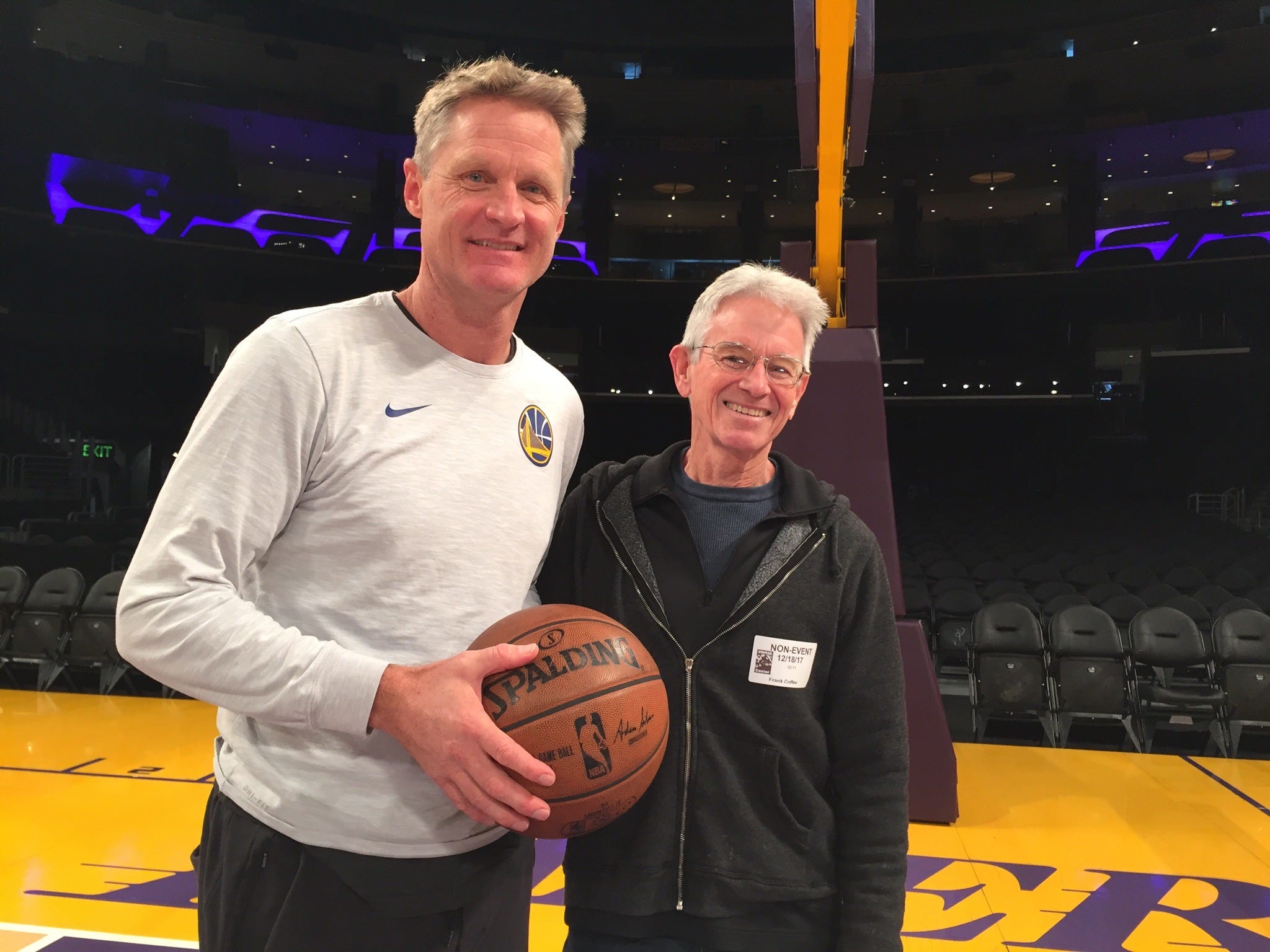
“Great to meet you, Frank,” Kerr said, extending his hand. My brother thought they were going right to the court, but Kerr sat down next to him.
“Tell me your story,” Kerr said.
They talked for almost half an hour about everything from basketball to cancer to the acute back pain Kerr was struggling with after surgery. Kerr had been extremely private about his ordeal, not even sharing it with his own kids. “Now I’m talking about it with a guy I just met,” Kerr said.
Warriors forward Draymond Green walked by, and Kerr said in an extra-loud voice, “I’ve got a lot of players on this team who think they can shoot threes.”
Green smiled.
“Cut it out, coach,” he said and kept walking.
Kerr stood up and said, “Let’s shoot.” They went to the free-throw line, and as my brother took the ball, he said he hoped the chemo-induced hand tremors didn’t act up.
“Here we go with the excuses,” Kerr said.
At one point, my brother went into a defensive stance as Kerr prepared to shoot.
“If people guarded me like that in my playing days, I’d be in the Hall of Fame,” Kerr said. My brother laughed.
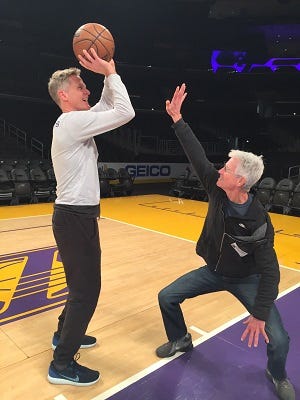
Kerr took 10 free throws and made them all. My brother took 10 and made six. He was annoyed, but for once he let it go. No balls were kicked. It was growth.
After spending over an hour together, Kerr and my brother walked out of Staples Center together. They had trouble finding the right exit in the cavernous arena and wound up meandering through corridors before they made it outside, near the main entrance. A group of teenage kids was there and recognized Kerr and rushed up to him.
“Take it easy on him, guys. I just schooled him in H-O-R-S-E,” my brother said. It wasn’t true, but he liked the line.
“Thanks a lot, Frank,” Kerr said.
They said goodbye, and Kerr headed off to the Warriors’ hotel, my brother to his apartment. That night, the Warriors beat the Lakers in overtime on a Kevin Durant jump shot. My brother watched every second. The next day, he was back at his happy place, the Venice Beach courts, and one of the first people he saw was Freddy, his unhoused friend.
“How ya doin’, Mr. No Miss?” Freddy said.
Wow! I always say that Wayne is the best little brother in the world. This proves it. Those Converse, size 3, sure were a good investment. xo
Nothing but net, Wayne. Goes directly into the Coffey pantheon next to your piece on Sam.