
Free to Dream
The World Cup is here. At Little Haiti FC, they are celebrating by doing what they've always done: let everyone play for free.

This is Coffey Grounds, a newsletter by me, Wayne Coffey — New York Times bestselling author and longtime journalist — about the people and stories that don’t make the highlight reel but probably should. More than 10,000 readers get a fresh post every Saturday, on me.
If you’re new here, welcome. If you’ve been reading for a while and want a full serving of Coffey Grounds, not just the Saturdays, please consider becoming a paid subscriber. Your support will enable me to keep doing this, and the monthly cost works out to about one-third of a ballpark beer, or two Starbucks coffees. What a deal.
Thanks for visiting Coffey Grounds.
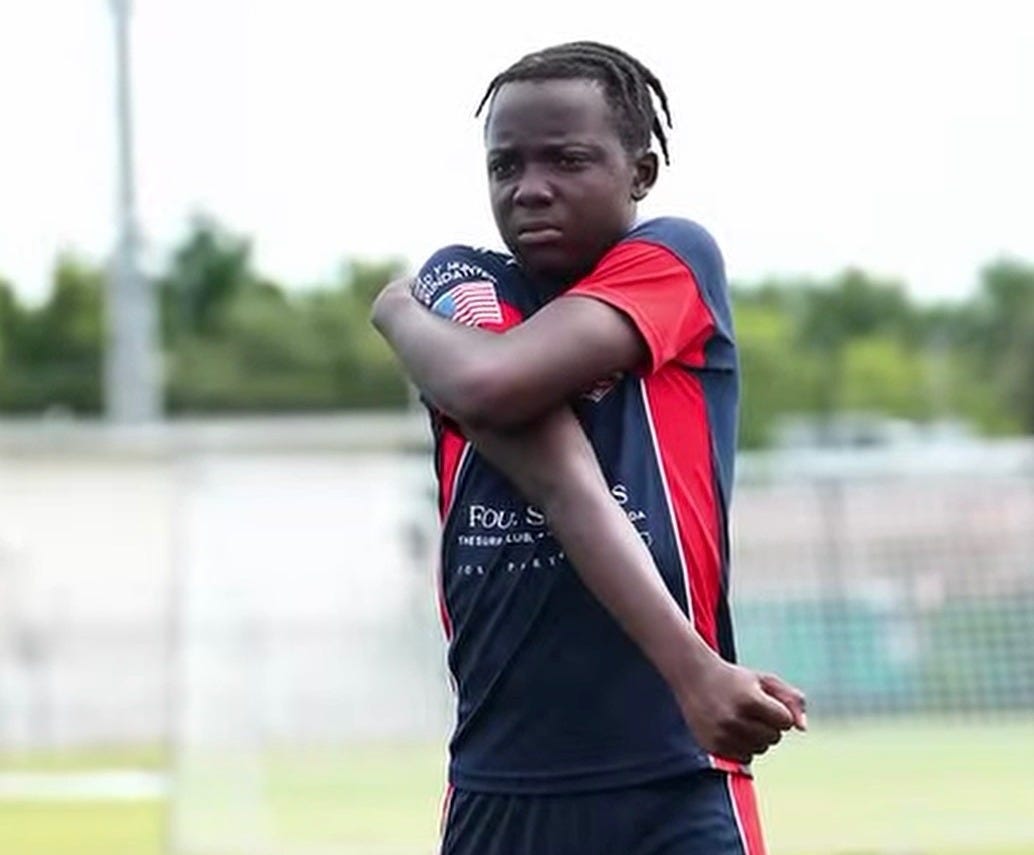
Ishaaq Zephirin knows exactly what he will be doing tonight at 9 p.m. Haiti will be playing its first World Cup match in 52 years — against Scotland in Foxborough, Mass. — and Ishaaq will be in front of a TV, riveted. He’ll be imagining himself wearing the red and blue Haitian uniform one day, believing in the possibilities ahead, thoroughly unmoved by the fact that Scotland, No. 42 in the FIFA world rankings, is heavily favored against the 83rd-ranked Haitians.
“I think Haiti is going to win,” Ishaaq said.
Ishaaq is a 13-year-old who lives in the heart of Miami’s Little Haiti neighborhood. He will enter eighth grade when he returns to school in August. He has been playing soccer for almost 10 years already and has no plans to stop anytime soon. He is one of over 400 kids, almost all of them Haitian-Americans, who are members of Little Haiti Warriors FC, a club that has been working an inner-city miracle for a dozen years, providing not only quality coaching, positive mentoring, and a safe place to play, but a nurturing structure and culture that has changed hundreds of kids’ lives for the better. The program started in Little Haiti and has since branched out to North Miami and North Miami Beach.
The high school graduation rate for Little Haiti FC players, boys and girls, is close to 100 percent. An estimated 80 percent go on to college.
All of this, at a cost of $0.
“Money isn’t everything, unless you don’t have any,” says Pat Santangelo, a former Florida state trooper and one of the program’s founders.
Humble beginnings
For decades, the American soccer development model has been pay-for-play. If you want to be good and get high-level coaching and have a shot at a college scholarship, you typically have to invest upwards of several thousand dollars annually to gain entry into a top-tier club. Then you factor in the costs of uniforms, equipment, tournament fees and travel expenses. Some people have no problem covering all that. Those people do not live in Little Haiti.
Little Haiti FC launched in 2014, quite by happenstance. A journalist and former University of Miami soccer player named Dave Villano was coaching the boys’ team at Ransom Everglades, a highly regarded private school in an affluent part of the city. One of Ransom’s main rivals was Miami Edison, a public school in Little Haiti that is overwhelmingly comprised of students from Haiti and the Caribbean.
“I was bowled over by their talent when I first saw them play,” Villano said. “Not just their raw talent, but their tight, cohesive team play. They were phenomenal.”
After a game against Edison, Villano approached Gomez Laleau, the coach of Miami Edison at the time. “Where do you guys play in the offseason?” Villano asked.
Laleau laughed.
“There’s no club soccer in inner-city Miami,” he said.
A month later, the two teams played again. Villano said we should do something to get a competitive club started for the kids that would not cost them a dime. Laleau brushed Villano off. Where would the money come from? Where would they play? Who would handle all the administrative details?
The obstacles seemed insurmountable. Villano was undeterred. After the high school soccer season ended, Villano reached out to Laleau again and made his case once more. Laleau finally began to come around. Maybe this could work, after all.
Laleau reached out to his friend, Pat Santangelo, who was chief communications officer for then-mayor Tomas Regalado and a man with a vast network of contacts in both the public and private sectors. The city provided a 10-year memorandum of understanding allowing the club to use Little Haiti Soccer Park. Villano and Santangelo scoured the community for funding sources. The club started with two teams but grew rapidly. For years, Laleau, the president of Little Haiti FC, would lose players before they even graduated high school, lured by gangs or drugs or the sirens of the street. It ripped his heart out every time. Now he had hope that that might change.
“Dave is an angel, and he was heaven-sent,” Laleau told a reporter. “I think God knew this program was needed.”
A pathway
Developing high-level soccer players is a core mission of Little Haiti FC, but its impact goes far beyond player development. The club offers structure, academic support, sometimes even helping families with food or finding housing or jobs, programming the founders hope will amount to a pathway out of poverty.
“People often criticize kids when they get in trouble,” Laleau said. “But in the summer, there’s nothing for these kids to do. We blame kids, but we never give them the tools to succeed.”
One of the longstanding benefactors of Little Haiti FC is the Dairy Farmers of America, makers of Sport Shake, a dairy drink that is wildly popular among Haitians. DFA has donated some $200,000 over the years to the club in addition to funding a brand new 15-passenger Ford van to help with player transportation. Ted Sowle is VP of sales and marketing for Sport Shake.
“The (non-soccer) parts of the program are even more important than the soccer,” Sowle says. “Everything about it is designed to help the kids be successful.”
Santangelo strongly dislikes asking people for money. When he wanted something as a kid — a new toy or bike — his father used to tell him, “Don’t wish for it. Work for it.” Now, fund-raising is a core part of his job, and he does it brilliantly.
“Pat makes the whole thing go,” Villano says.
Even as the club continues to grow, it remains free for all. The only salaried employees are the coaches and the operations manager, Lavanda Frances, who handles all of the administrative and logistical details. Everyone else volunteers. Little Haiti FC’s operating budget this year is $350,000. Apart from Sport Shake, the club’s biggest supporters are former Miami mayor Francis Suarez; Inter America Development Bank; the Brady Hunter Foundation; Four Seasons hotels; Redwood Development Co. and Pinecrest Rotary Club.
And then there is FIFA. Last month, a $250,000 grant from the charitable arm of the world governing body arrived in the Little Haiti Club coffers. It doesn’t hurt when you have FIFA president Gianni Infantino, the most powerful man in global soccer, in your corner. For all the criticism FIFA gets for its price-gouging and its projected $11 billion profit from this year’s World Cup, Infantino has long been a vocal advocate for making the game available to everyone, and a vocal critic of pay-for-play. Last month, Infantino stopped by Little Haiti FC Soccer Park to attend a tournament and help celebrate Haitian Heritage Month. It was the second time he stopped to see the kids at Little Haiti FC.
“Infantino’s visits demonstrate to the Little Haiti FC organization, the players and their families that all the struggles and hard work over many years is respected and supported at the highest levels of the sport,” Santangelo says.
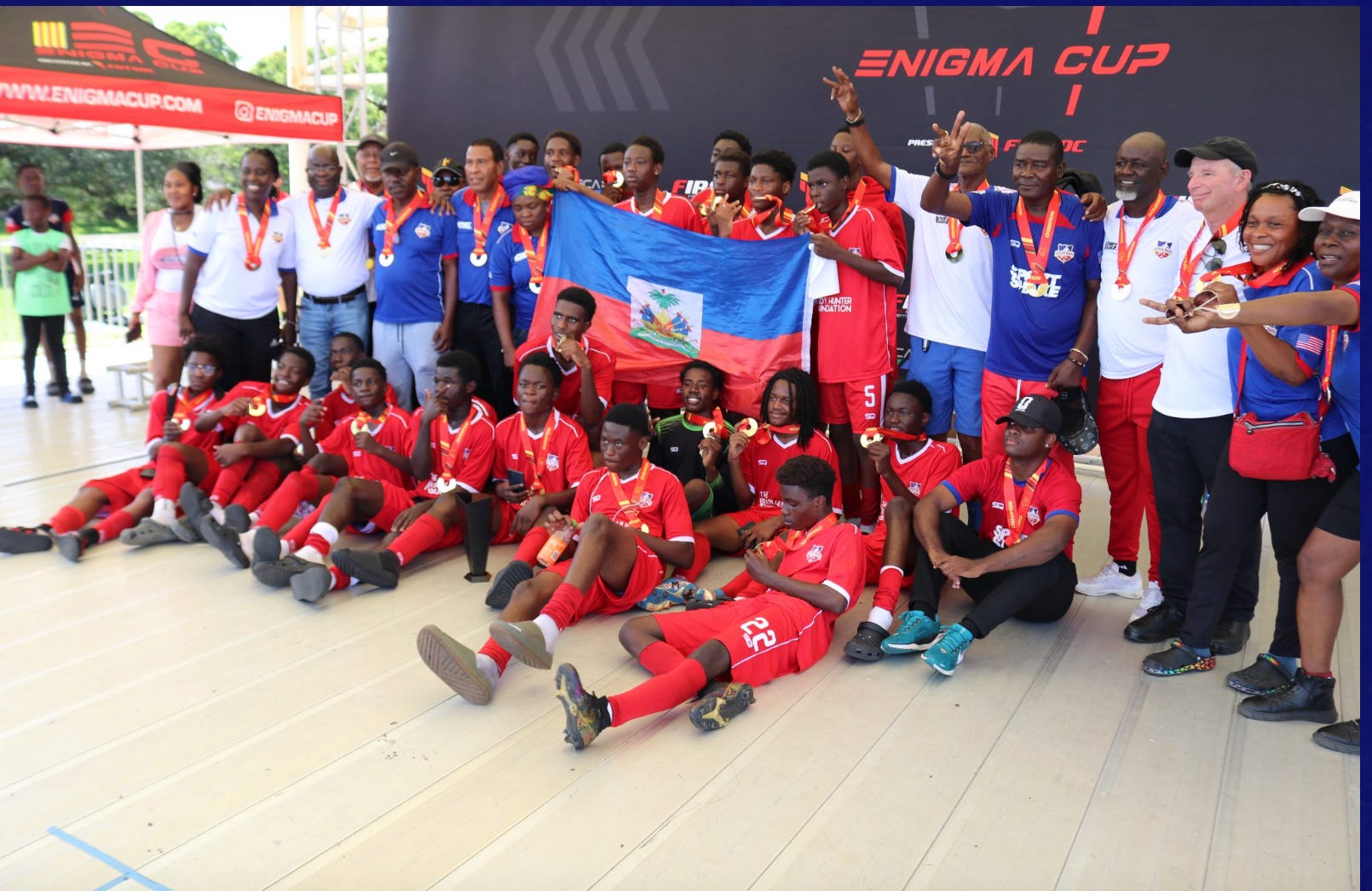
Little Haiti FC is on a major roll. The Haitian consulate in Miami recently invited some club members to visit Haiti’s World Cup training site in Port St. Lucie. The club’s U-17 team just won the Enigma Cup, a prestigious international competition. A number of players, male and female, are playing semipro soccer this summer in the United Professional Soccer League, and more and more kids are finding their way to college. So often, the stories that come out of Haiti are about death and despair and crushing poverty. The narrative for now is more hopeful, rich with possibilities. Haiti will play its first World Cup game in more than half a century. Ishaaq Zephirin’s dream is to one day wear his country’s uniform. In the meantime, he’ll be rooting for his countrymen in Foxborough tonight and grateful for the club that has changed his life.
“I like everything (Little Haiti FC) – the coaches and the vibe,” Ishaaq says. “It makes me happy when I am there. It gives me a lot of confidence. Being with my teammates and making new friends — it feels like home.”
Great story, Wayne. I hope it will generate some more donations.
Great story. You know how I feel about positivity. So little of it these days. I’ve never been a fan of pay-for-play, which excludes so many children who just want to play. We need more of these clubs. And thanks for presenting a bit of a positive quality of Infantino; it’s so easy to dislike him.