
An Unfairytale
Sometimes you win when you deserve to. Sometimes you don't.

In the famous first sentence of The Road Less Traveled, M. Scott Peck writes, “Life is difficult.” He might’ve added: “Life is unfair.” Does Dr. Peck, whose book has sold seven million copies or so and been translated into a billion languages, need me to weigh in on his work? No, I think he’s good. But for me, somehow the unfairness can be more troubling to reconcile than the difficulty.
It was the final seconds of the fifth and deciding game of the WNBA championship series between the Minnesota Lynx and the New York Liberty Sunday that got me thinking about fairness, or lack thereof. The Lynx, four-time league champions, had a 60-58 lead. Liberty star Breanna Stewart took the inbounds pass with just over six seconds left in regulation. She dribbled into the lane and went up awkwardly for a shot. In the previous timeout, Liberty coach Sandy Brondello told her players, “If they foul you, embellish it, to get the foul.” Defending Stewart was the Lynx Australian forward, Alanna Smith. One of the best players in the Paris Olympics who helped the Aussies win a bronze medal, Smith closed in to contest the shot, going straight up, with her hands overhead. It’s hard to determine whether Stewart embellished anything, but her shot clanged off the rim, and the whistle blew. Smith was called for a foul. Lynx coach Cheryl Reeve challenged the call and it went to review. After a minute or two, the lead official said that Smith “was not in a legal guarding position,” whatever that means, ruling that the call would stand.
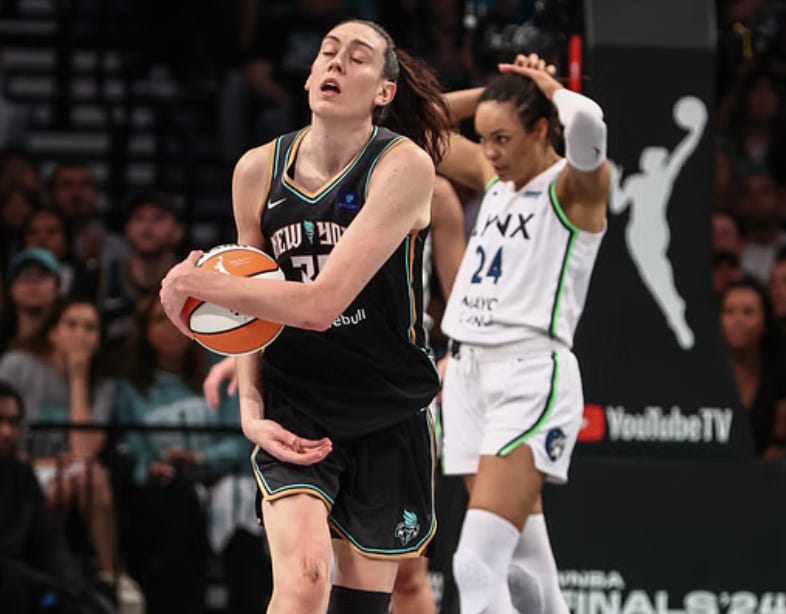
Breanna Stewart
Much to her credit, Stewart, who had missed two free throws a short time before, stepped to the line and made them both to tie the game. The Liberty decisively outplayed the Lynx in overtime and ended a 28-year drought by winning their first WNBA title, 67-62.
Now let me pause here to interject that I’ve closely followed Breanna Stewart’s game from the time she was a UConn freshman, when she was the best player on a championship team and Most Outstanding Player of the Final Four. She would go on to win three more titles, and three more MOP awards. There has never been another career like it in the history of college basketball, male or female. At 6-foot-4, Stewart can block shots and rebound like a center, and shoot threes and see the court like a guard. She has re-imagined how the game could be played, helping the U.S. capture three Olympic gold medals and establishing herself as one of the best players in the world.
As a former girls’ high school coach, I’ve long admired the versatility of Stewart’s game, and her knack for finding ways to win. I was rooting for her and the Liberty to finally get their title. And yet, as the confetti swirled and Frank Sinatra’s “New York, New York” blasted through the Barclays Center,” I felt awful about the way that the Liberty got there - via an egregiously unfair call.
Or as Cheryl Reeve said in the postgame interview, “This s*** was stolen from us.”
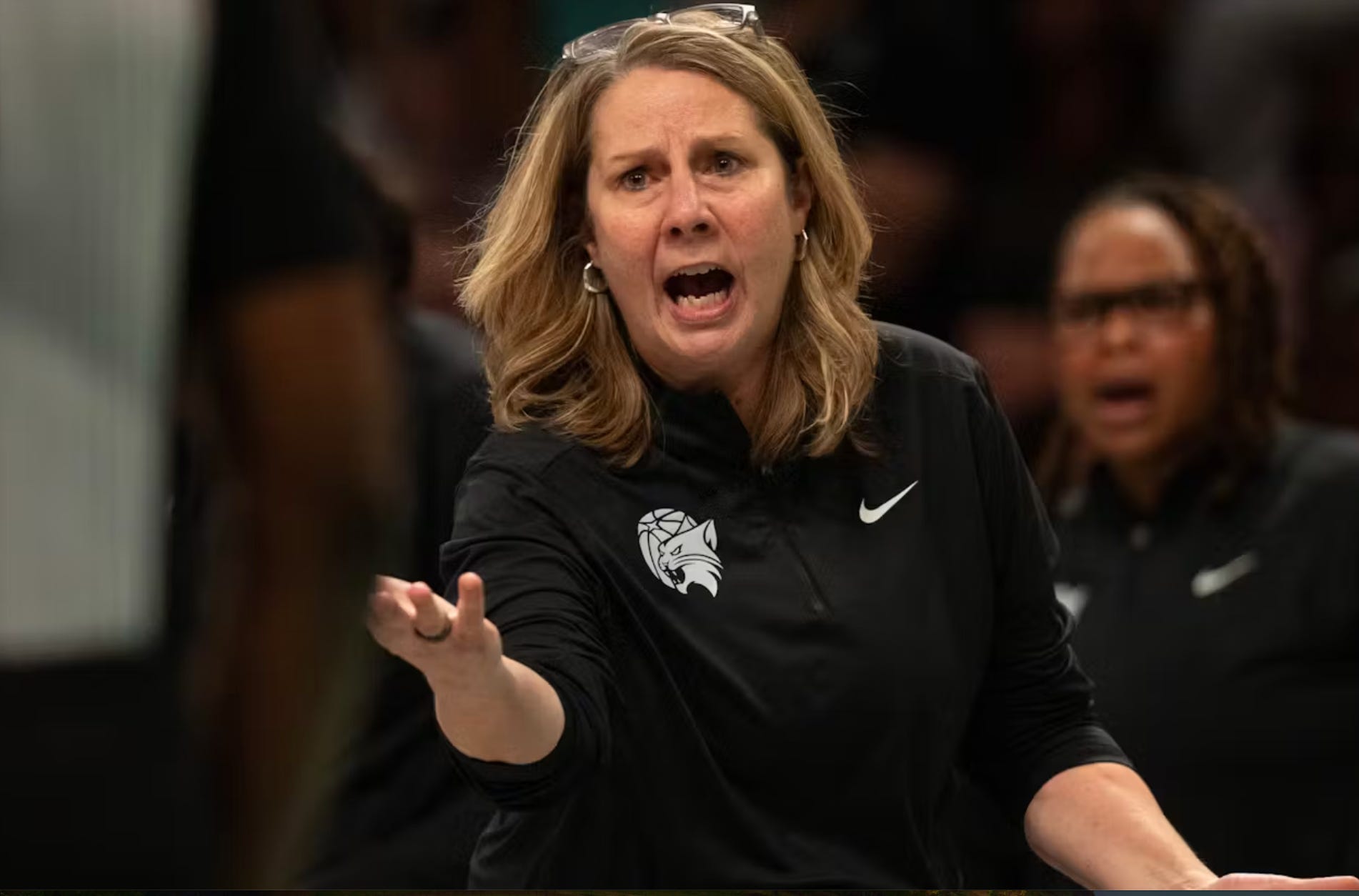
Cheryl Reeve is not happy.
Of course, the custom of coaches complaining that their teams are getting screwed by the officials has been going on almost since Dr. Naismith hung up his peach baskets in Springfield, Mass. Coaches do this because it works. After the Lynx won Game 4 in Minnesota, Brondello noted that the Lynx went to the free-throw line 20 times to the Liberty’s 9.
"All we want is fair, OK,” Brondello said. “So if we are getting hit, that's a foul. You know, I'm one of the nicest bloody coaches in this league, but this pisses me off. Just be fair."
In Game 5, the Liberty shot 25 free throws to 8 for the Lynx. Was it Brondello’s tirade, or just home cooking? Either way, Brondello got the desired result.
Alanna Smith defended Stewart aggressively in those final seconds, but she did not foul her. Not with her upper body, or her lower body. Multiple replays show that. Even LeBron James weighed in on it. https://x.com/KingJames/status/1848186199657324563
Much worse, though, was that the refs completed whiffed on Stewart’s traveling violation before she shot. As she turned into the lane after getting the in-bounds pass, Stewart momentarily bobbled the ball and then took three, maybe even four, short steps before she put the ball on the floor. It was traveling in any universe.
The Lynx had a chance to win in regulation, but guard Kayla McBride missed a three-pointer from the top of the key. They also made zero shots and had five turnovers in overtime. You can absolutely argue that if the Lynx had played better the game wouldn’t have come down to a missed traveling call, and that they just needed to power through the ref’s screwup and failed to do that, so they got what they deserved. Isn’t that what champions do? Find a way to rise above missed calls or bad luck? Yes, it is. But that doesn’t stop me from feeling cheated that a wrong whistle (and missed violation) determined the outcome of an epic championship series. LeBron is right; let the players decide it. It was the same feeling I had when I was covering the 1989 NCAA men’s basketball championship game in Seattle’s Kingdome in 1989. Seton Hall had made a magical run through their first six games and was leading Michigan by a point in the final three seconds of overtime. Michigan guard Rumeal Robinson drove into the lane, guarded by the Hall’s Gerald Greene. There was the slightest of contact. Official John Clougherty, who always said he made it a point not to make a borderline call to decide a game, blew his whistle. Robinson made both free throws, and Michigan won 80-79.
The thrill of sporting events is that the outcome is unscripted. It’s why we watch, after all; we don’t know what’s going to happen. (Don’t get me started on the conspiracy crowd that is forever shouting that the outcome was rigged whenever it doesn’t go their way.) You want your team to win, yes. Ideally, you would hope the victory comes fairly, powered by skill and poise under pressure, but there are no asterisks in the record books if it doesn’t. You can be sure Breanna Stewart and her teammates are feeling no guilt or remorse about how things played out at the end of Game 5, nor should they. It just stinks that human error was such a big part of it. Cheryl Reeve is entitled to her anger, just as Sandy Brondello was after Game 4. Unfairness, it turns out, is often equitably distributed, as Peter Ustinov noted.
“Life is unfair, but sometimes it is unfair in your favor,” he said.