
73 -0
Dec. 8, 1940 . . . The Bears were sensational. The Redskins were awful. History was made.

Bulletin board material has been around for as long as people have played sports. No, not cork . . . the time-honored practice of coaches, managers and athletes themselves using a published/posted/spoken taunt or insult as motivational fuel. It is particularly favored by football coaches, who have a whole week to stoke their players’ emotional fires. An acknowledged master of the craft was Bill Belichick. After Rex Ryan got his first head coaching job, with the New York Jets in 2009, he announced, “I never came here to kiss Bill Belichick’s rings. I came to win. Let’s just put it that way. So we’ll see what happens. I’m certainly not intimidated by New England or anybody else.”
Je’Rod Cherry, a special-teams stalwart for three of the Patriots’ Super Bowl victories, knew what was coming.
“It’ll be laminated, maybe even a banner over the stadium,” Cherry said. “Bill is a smart, crafty guy. He will present it as blatant disrespect for the guys who were there throughout that run of Super Bowls, and he will use it to help the new guys identify with the Patriots’ legacy. It will be a rallying call.”
By the time Ryan’s coaching career was over, his head-to-head record against Belichick was 4-12. You don’t get to be the greatest coach in NFL history by playing mind games, of course, but it can be useful to have in your toolbox. Perhaps no coach in history got more mileage out of disrespect than George Stanley Halas, the fabled Papa Bear, who began his career as a player-coach for the Decatur Staleys in 1920. Halas was 25 years old. He won his first game against the Moline Universal Tractors, 20-0, and did a bunch more winning across the next five decades. In addition to his 318 victories for the Bears, Halas won five NFL championships. The most memorable of them happened on this date, 85 years ago.
The Bears, Western Division champions, came into Washington’s Griffith Stadium to play the Redskins, the Eastern Division champions. The teams had squared off on that same field just three weeks earlier. The Redskins prevailed, 7-3, and their owner, George Preston Marshall, opted not to be a gracious winner, calling the Bears “quitters” and “crybabies.” An unrepentant segregationist, Marshall wasn’t gracious about a lot of things, stating at one point, “We’ll start signing Negroes when the Harlem Globetrotters start signing whites.” (The Washington football team didn’t have a player of color until 1962, when Bobby Mitchell joined the club. The club was the last NFL team to integrate.)
Halas took note of Marshall’s insults, and made sure his players did, too.
“Gentlemen, this is what George Preston Marshall thinks of you,” Halas told his team before the game. “Well, I think you’re a GREAT football team! Now, go out there and prove it!”
The game was carried on the Mutual Broadcasting Network, with Red Barber at the mike. It marked the first national radio broadcast of an NFL championship game. The Bears wasted no time commencing with their mission. On the second play from scrimmage, running back Bill Osmanski went 68 yards for a touchdown. The Redskins responded by driving to Chicago’s 25-yard-line. Receiver Charlie Malone dropped what would’ve been a certain touchdown in the end zone. It was the closest the Redskins would get to scoring.
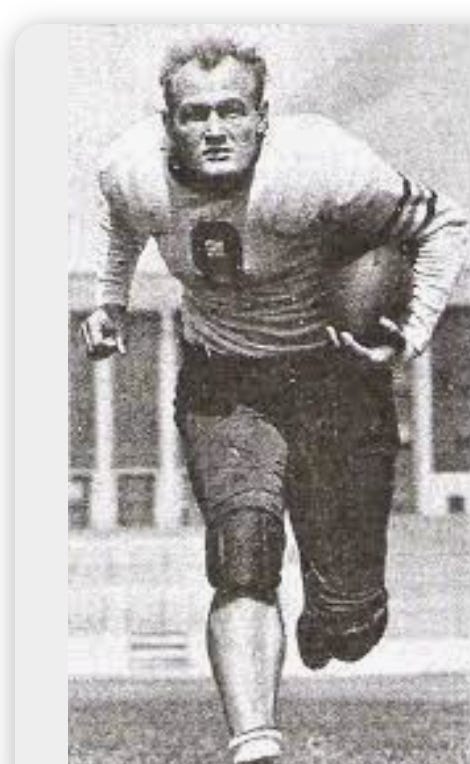
(Bullet) Bill Osmanski
The Bears scored two more touchdowns before the first quarter was over, and led 28-0 at halftime. They pushed the lead to 35-0 to start the third quarter when Hamp Pool scored on a 15-yard interception return, the extra point added by Dick Plasman, a 6-foot, 4-inch strongman who had an electrical engineering degree from Vanderbilt and was the only player on the field that day without a helmet. (Plasman was the last helmet-less player in NFL history.) Now the deluge began in earnest. The Bears scored twice more on interception returns in the quarter, finishing the day with eight interceptions and a fumble recovery. The turnover battle was no more even than the game.
“It was just one of those games where we did everything right and the other team did everything wrong,” Halas said.
When the score hit 48-0 late in the third quarter, the PA man announced to the sellout crowd that Redskins’ season tickets for 1941 were available for purchase. Most of the 36,000 fans in Griffith Stadium booed. After the Bears scored their ninth touchdown, the referee asked Halas to stop kicking extra points because they were running out of footballs. (This was the pre-net era, when kicks went into the stands and fans kept them.)
The final statistics of the game were mind-boggling. The Bears rushed for 382 yards, the Redskins for 22. Flingin’ Frankie Filchock, the backup QB to Slingin’ Sammy Baugh, completed almost as many passes (5) to the Bears as he did to his receivers (7). Improbably, the Redskins had the same number of first downs as the Bears (17), but that was only because the Bears had so many big-yardage plays. To go with their nine turnovers, the Redskins also committed eight penalties. Sid Luckman, the Chicago quarterback, only threw four passes, completing three for 88 yards. Why throw when you average nearly seven yards per rush?
Marshall was not as chatty as he had been following the previous game between the teams. His only comment to the press was, “We needed a 50-man line against their power.
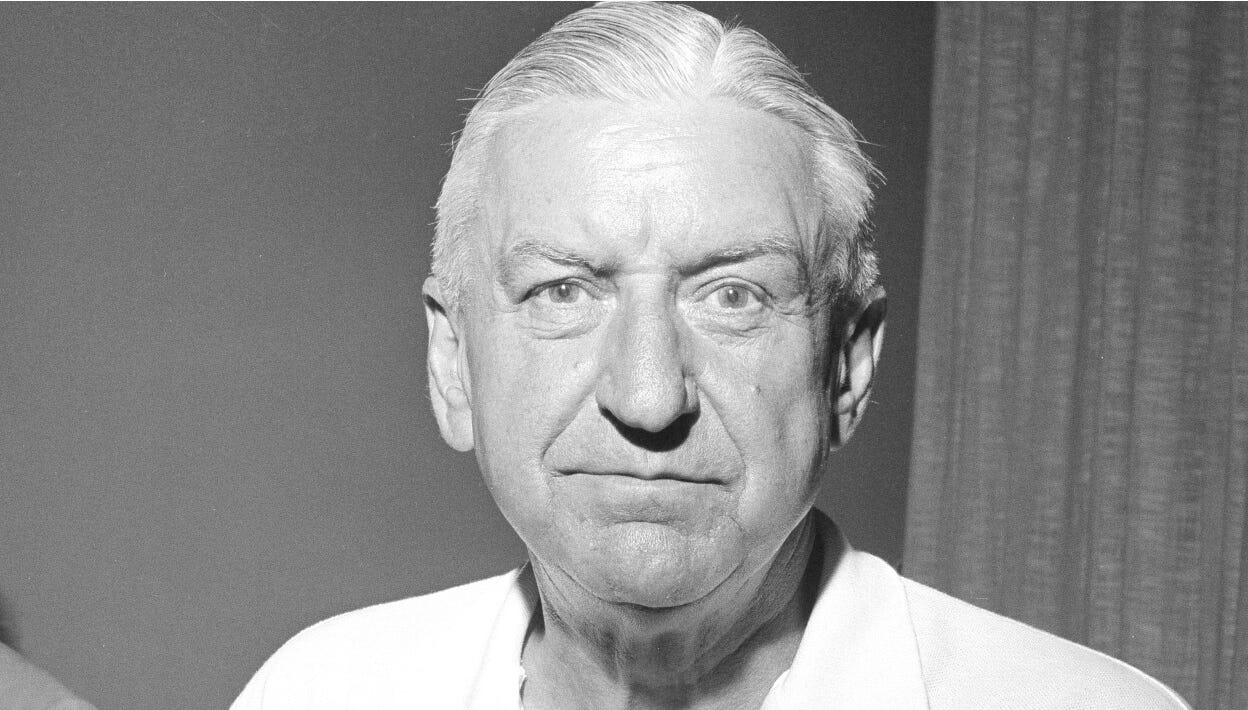
George Preston Marshall
The margin of victory – 73-0 – remains not just the largest of any game in NFL history; it is the largest in any major-league American sport. Four years ago, the Memphis Grizzlies had a 78-point lead late in a game against the Oklahoma City Thunder, but the Thunder rallied. The Grizzlies had to settle for tying the Bears’ mark, winning by152-79.
In the Redskins’ locker room, Baugh reportedly was asked if the outcome would’ve been different if Malone hadn’t dropped the ball early in the game.
“Sure. The final score would have been 73–7,” Baugh said.
In the other locker room, a Bears player got hold of a piece of chalk. He wrote on the wall, in big letters: “Who are the crybabies now?”
Failed to render LaTeX expression — no expression found
My Dad was at that game. He was on his way home to Brooklyn from the University of Virginia. He and a friend walked up to the ticket booth at Griffith Stadium, paid his $2.50, and saw history.